Libraries die when field contribution is optional, distribution is passive, and ownership sits on one hero. Then that person leaves, or a big deal eats the calendar, and the AI center of excellence becomes a quiet wiki.
We designed a pre-sales CoE against that failure mode for a software company of about 500 people. An operating problem, not a tool shopping trip: demo engineering, AI practice for customer talks, and a library consulting teams could pull from.
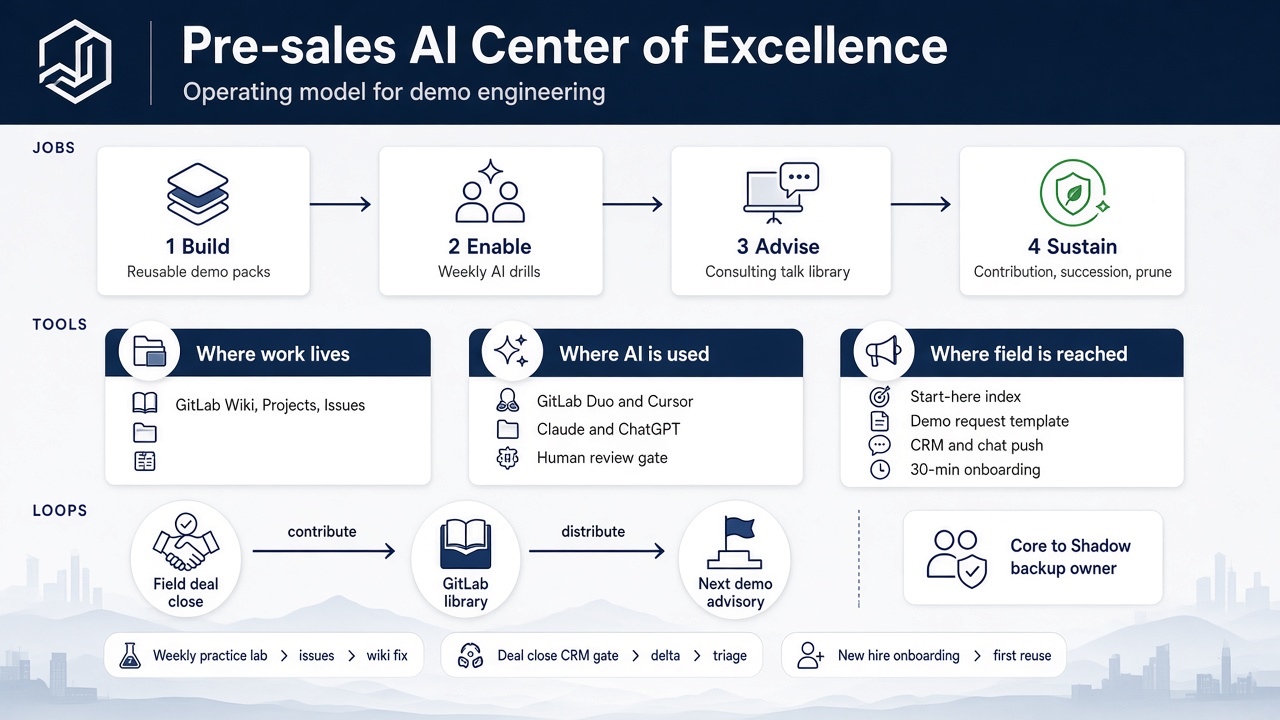
What the CoE had to do
We scoped the center of excellence to pre-sales. Four jobs mattered:
Build. Reusable demo pieces, scripts, and data setups. Not one-off hero demos.
Enable. Short drills so account teams learn AI practice.
Advise. Consulting and advisory packs for when a customer asks, “Show me how this works for us.”
Sustain. Contribution SLAs. Owner succession with a shadow lead. A monthly kill/keep review so dead demos do not rot the library.
If the CoE only bought seats and posted a policy, Monday demos would not change.
How we ran it
We sat with the CTO, pre-sales leads, and demo engineers. AI was already in use: ChatGPT and Claude for talk tracks, GitLab Duo in the IDE, Cursor for demo code. It was uneven. Almost nobody could point to a shared source of truth.
1. Named owner, small core team, shadow owner, and a runbook.
One leader owned the CoE calendar. A small demo-engineering group owned the library. We named a shadow owner for when the lead was out. The runbook covered the weekly lab, issue triage, wiki merges, and kill/keep. Ownership rotated each quarter. Twenty sponsors and no builders will stall. One hero and no backup will stall later.
2. A data and prompt boundary on one page.
Do not paste customer names, deal data, private pricing, or regulated content into public ChatGPT or Claude. Use approved enterprise seats, or GitLab Duo and Cursor inside company projects, for work that touches those details. Anything customer-facing still needs a human review. This is not legal advice. Teams that sell into regulated buyers already hear SOC 2 or FedRAMP as concepts. We did not claim certifications for Jiara or invent a customer badge.
3. The demo library as the product, plus a minimum viable set.
We built a living library on the GitLab wiki, with GitLab projects for demo assets. Each pack had the customer problem, demo path and sample data, AI prompts, a “do not say” list, a short advisory blurb, and a one-page demo brief for common RFP shapes. Gaps lived as GitLab issues. Five starter packs were the minimum viable library if practice skipped a week.
4. Contribution was mandatory, short, and timed into the deal.
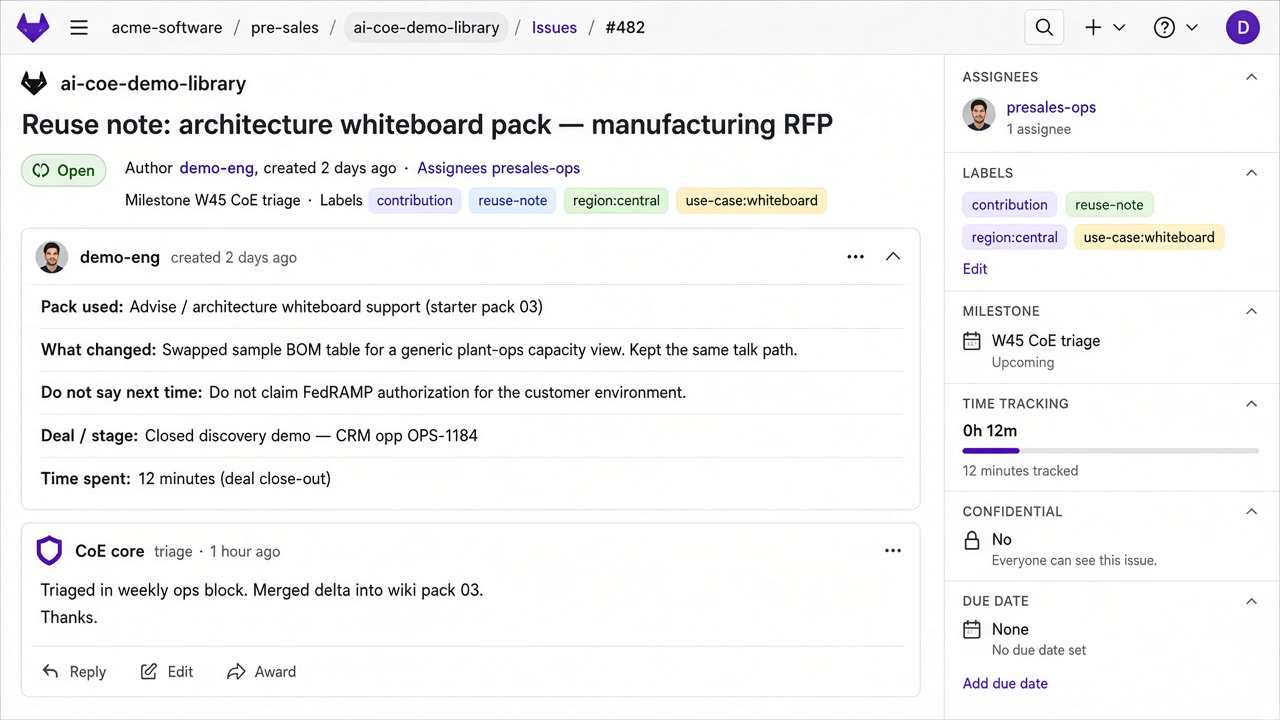
Voluntary uploads did not work. With the CTO and pre-sales managers, we set a contribution SLA. After a major demo or a closed CRM stage, someone on the deal filed one GitLab issue from a short template: which pack they used, what they changed, and one thing not to say next time. That was deal close-out work, not unpaid hero homework, capped at about 10 to 15 minutes. Managers checked the issue link in one-on-ones and quarterly goals. No separate review meeting. Pre-sales ops owned the backlog gate and spent a fixed weekly block with CoE core to triage and merge. That block came from existing ops capacity, not new headcount. If a region filed nothing for two cycles, ops escalated to that region’s pre-sales lead.
Example from acme-software / pre-sales / ai-coe-demo-library:
5. Distribution was a path, not a folder.
GitLab wiki and projects are storage. Distribution meant a “start here” index with search tags, a demo request issue template, a CRM stage note for the pack used, and a weekly “pack of the week” push in the chat channel pre-sales already used. New hires got a 30-minute onboarding pack: three starter demos, the boundary page, how to file a contribution issue, and first reuse. The loop was find → reuse → improve → check in.
6. A weekly practice loop that produced library check-ins.
One demo pack per week. Demo engineers used Cursor and GitLab Duo on sample code. Writers used Claude or ChatGPT for talk tracks, then a human edited for voice. We logged breakage in GitLab issues and fixed the wiki the same week. Practice ended with a library PR or wiki check-in. If a lab week slipped, the contribution SLA still moved the library forward.
Practical moves we used
These are checks we would run again, not a universal template.
1. Inventory AI touchpoints in pre-sales only. Name an owner for each tool.
2. Pick five consulting use cases first. Discovery prep, objection handling, architecture whiteboard support, competitive teardown drafts, and demo follow-up notes.
3. Write the contribution rule into deal close-out. One short GitLab issue after a major demo or stage close, about 10 to 15 minutes, counted as close-out time. Manager checks the link in one-on-ones. Ops and CoE share a fixed weekly triage block. Escalate when a region goes quiet.
4. Design the distribute path. Start-here index, request template, CRM note, chat push, onboarding pack. Find → reuse → improve → check in. People should reach a pack in about two minutes.
5. Enforce the review and security gate. Boundary page for public chat versus Duo and Cursor. Human pass on anything customer-facing.
6. Make practice produce library PRs. Lab output lands as an issue fix or wiki update the same week.
7. Measure health, not seats. Reuse rate, contribution coverage by team, days since last field contribution, backlog age, time-to-first-demo for new hires.
What changed
We do not publish win rates or customer names. The outcome pattern was clearer demos, less scramble, and a practice new hires could learn without the original champion. After a busy season, the minimum viable packs and the contribution SLA kept the library moving. When a core owner left, the shadow owner and the runbook kept the loop alive. Reuse rose. Contribution coverage by region became visible. Backlog age and time-to-first-demo improved.
Who this is for
This is for CTOs and pre-sales leaders at mid-size software companies who want a pre-sales AI CoE that survives busy calendars and exits. It is not a promise a CoE will raise revenue on its own.
If you want help scoping a practice like this, tell us team size, demo load, and tools in use. Start at Contact.